When browsing the articles from Writers on Writing, I was instantly drawn to Joyce Carol Oates. My second semester of college I took an Interpersonal Communication course where Oates' novel, We Were the Mulvaneys, was required reading. I loved it when I first read it and it is still one of my favorite novels to this day. I was pleasantly surprised when Oates' perspective on writing was very similar to my own. In her Writers on Writing piece, 'To Invigorate Literary Mind, Start Moving Literary Feet,' Oates says, "I've never thought of writing as the mere arrangement of words on the page but as the attempted embodiment of a vision..." (Oates, 1999, para. 25). I completely agree with this because when I write, I don't do it just for the sake of writing. I do it because I want to write down a great idea that I've seen in my head, preserve a memory, or relive a dream.
Oates believes that writing and running (or being in motion in general) go hand in hand. She discusses Henry David Thoreau's need "to spend more than four hours out of doors daily, in motion" (para. 7), Charles Dickens' "compulsion to walk and walk and walk in the darkness and pattering rain" (para. 8), and Henry James' "[love] to walk for miles in London" (para. 9). For Oates, walking and running allows her to visualize an idea for a novel. Before she puts any ink to paper, she has run for miles visualizing the setting, the characters and the story. "Running seems to allow me, ideally, an expanded consciousness in which I can envision what I'm writing as a film or a dream...By the time I come to type out my writing formally, I've envisioned it repeatedly" (para. 24-25). Running is a way for writers to "unsnarl" the the tangles of an envisioned story, and keeps the writer sane (or as sane as a writer can be, Oates decides).
Oates also says that writing is a process of "continuous revision." Whenever she writes a new chapter in a book, she rereads through everything she has written before. When she writes the final few chapters in a book, she rereads the beginning chapters to make sure that they are uniform. "On days when I don't run, I don't feel 'myself'...and the writing remains snarled in endless revisions" (Oates, 1999, para. 5). I feel the same way on days when I'm trying to write a paper or a story. I feel claustrophobic sitting inside and trying to pound out pages of text, but a quick walk on the Erie Canal or a trip to the park with my Golden Retriever completely clears my mind and allows all of my thoughts to untangle. If anything I've written this semester has seemed coherent it is because I spent most of my time outside thinking about what I was going to write rather than actually sitting at a desk and writing it. Some people think of that as procrastination, but to me it makes all the difference. "Both running and writing are highly addictive activities; both are, for me, inextricably bound up with consciousness. I can't recall a time when I wasn't running, and I can't recall a time when I wasn't writing," and I believe many writers, including myself, feel the same (Oates, 1999, para. 14).
Throughout this course my idea of a writer's perspective in the social media environment has definitely changed. I had never really thought twice about the things I posted on social media until this course. I had never posted things that would hurt others or that I would be ashamed of certain people seeing, but I also wasn't actively vetting the information I was sharing with others. Social media allows the instantaneous flow of information, so it is imperative that everything we create or share through these outlets is as accurate as possible. This helps build your credibility which is extremely important in the new media environment where anyone can post anything no matter how accurate it may be. At the same time, though, social media is a great platform for writers to network and gain a following. Twitter, Facebook and even Tumblr allows for writers to get potential readers excited about what they have in store for them without shoving their work down their audience's throat (Petronzio, 2012). If used effectively, social media can garner positive results for writers if they choose to partake in it.
Resources
Oates, J.C. (1999, July 18). To invigorate literary mind, start moving literary feet. The New York Times. Retrieved from http://www.nytimes.com/library/books/071999oates-writing.html
Petronzio, M. (2012, February 2). 10 pro tips for writers using social media. Mashable. Retrieved from http://mashable.com/2012/02/02/social-media-writers/
Living in the Age of New Media
Sunday, September 1, 2013
Friday, August 16, 2013
Multimedia Tools
Content and the way it is presented on a website is what can make or break it. The content of a website has been compared to a cupcake: the actual text is like the cake and the multimedia elements are like the frosting (Sniderman, 2010). Both are needed to satisfy an audience. While the text of a website can relay major information to the reader, multimedia in the form of audio, photos, videos, slideshows, or additional links, keep the reader engaged and coming back for more. Depending on the content of the site, certain multimedia elements may work and others may not. The important thing to remember is that your multimedia elements should support what you are trying to convey to your audience and should not distract them from it. Every audience member learns differently, so multimedia allows a content producer to provide both textual and visual elements to deliver their message. For those audience members who understand information by reading about it, the textual elements will work well. For audience members who like to see for themselves how things are done or how something happened, video, pictures and slideshows will be effective.
The article "Snow Fall: The Avalanche at Tunnel Creek," which was published on NYTimes.com, was a multimedia feature that not only provided in-depth text describing the event, but provided pictures, videos, time-lapses, maps and animation of how the event transpired. I was reading the piece in 80 degree weather and I felt like I was actually on the mountain with the group. Visuals of the mountain itself and snow falling, along with pictures of the group and videos of the survivors, made the story come alive. Not only was I reading about the tragedy, but I felt like I was experiencing it with them. That is what an audience is looking for when they view a website or a blog. Not only do they want to understand the information being presented, but they want to be entertained. Multimedia keeps an audience engaged and focused. Without the visuals for this story I think the audience would have stopped reading a quarter of the way through. The story was incredibly interesting, but because it was a feature piece it was quite long and without the images and interviews I think the audience would have gotten bored and moved onto something else.
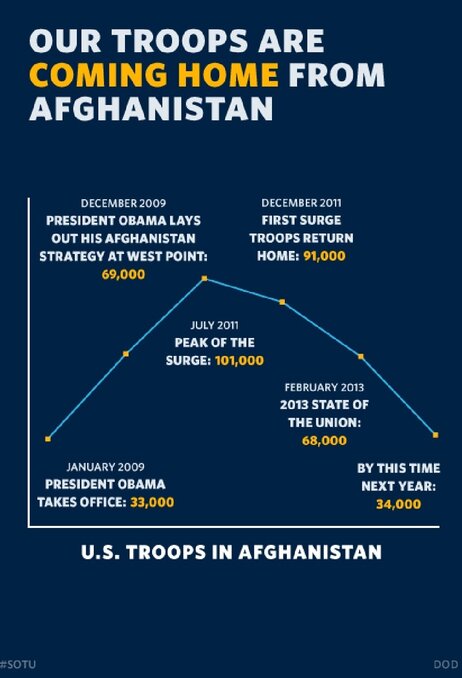
During President Obama's 2013 State of the Union address, his team launched a multimedia presentation that coincided with his speech that included 107 slide and 27 charts. While the multimedia presented the information "simply, clearly and honestly," some of the charts were misleading because of the way they were designed (NPR, 2013). This chart depicting the amount of U.S. troops in Afghanistan, for example, has no labels on either axis, and the time that passes between each point on the chart is not equal, yet the space between the points makes it look that way. It also pinpoints on the chart a future number that may or may not actually happen. This can be misleading. There were multiple other charts that had similar problems. The moral of the story is that if an individual is going to utilize multimedia elements, they have to be sure that even if the information presented is accurate, that it is not misleading the audience just to support your conclusion. In this case, although the information presented was accurate, it was misleading, and did not necessarily do the job it was meant to do.
Multimedia should support and add to the information that is presented in text form. Multimedia keeps the audience engaged and gives people who learn better through visuals the ability to take in the information as successfully as those who are more comfortable with viewing information in text form. The subject of the particular website or blog will ultimately dictate which multimedia will best enhance the information being relayed.
Resources
Branch, J. (2012, December ). Snow fall: The avalanche at tunnel creek.The New York Times. Retrieved from http://www.nytimes.com/projects/2012/snow-fall/?_r=0#/?part=tunnel-creek
NPR Staff. (2013, Feb. 14). Chart check: Did obama's graphics 'enhance' his big speech? NPR. Retrieved from http://www.npr.org/blogs/itsallpolitics/2013/02/13/171935151/chart-check-did-obama-s-graphics-enhance-his-big-speech
Sniderman, Z. (2010, July 28). How to: Add Multimedia to your blog. Mashable. Retrieved from http://mashable.com/2010/07/28/add-multimedia-to-blog/
Tuesday, August 6, 2013
Blogging Best Practices
There are many things that make a blog great. Blogs should be entertaining and bloggers should give their readers what they want to hear and see. In my opinion, bloggers should be held to the same standard as journalists--they have a responsibility to their audience just like journalist's have to the public. After reviewing "12 Steps to Launch a Successful Blog" and the Food Blog Code of Ethics as well as my own experience, I have compiled a short list of what I would consider the "best practices" of blogging:
1. Be Passionate and Committed.
No one wants to read a blog from someone who is writing just to write. That makes all the content seem bland. Readers will be more enticed when they can tell that you really care about what you're writing about. In addition, bloggers should make sure that they post new content least once a week to keep readers coming back for more.
2. Make it Appealing.
If your blog is pleasing to the eye, your readers will be able to easily see your content. Too much going on in the background or crazy color combinations can distract from the information you are trying to provide to your readers. Images are always helpful. It breaks up all of the text and makes the blog more interesting to read. A banner that coincides with the theme of your blog as well as tabs where readers can navigate to specific posts are also helpful. The easier it is to see where everything is and the easier it is to access the more likely people will stick around to see what you have to offer.
3. Be Original.
People want to follow a blog that puts out original content. If they can get the information elsewhere beforehand, why would they wait to get the information from you later on? Another part of being original is not stealing other people's work. You have to make sure that you cite your sources and that you ask permission before reproducing someone's copyrighted work. Why take the chance of stealing someone's work when being unique is what will ultimately make you stand out.
4. Be Responsible.
It is vital that bloggers be responsible about what they post. Just as journalist's must do their best to check sources, as should bloggers. If you put out information that was inaccurate, you must take the responsibility for and own up to that mistake. No one told you what to write in your blog, so you are the one who must take the fall for misinformation. If you continually put out information that is accurate, your readers will likely stick with you because they anticipate this. Bloggers should also make sure they are transparent when it comes to sponsors and gifts that they receive. This transparency helps readers to understand your bias' and that can lead to trust between the blogger and the audience.
5. Be Nice.
This one is really a no-brainer. If you are nice to people, people will be nice to you. If you are rude or mean to your audience, why would they want to stick around and read what you have to say? Take all criticism with a grain of salt, no matter how obnoxious a comment was. Showing class and taking the high road will win you more readers than responding negatively to others. There will always be one person who is determined to bring a successful person down, so do not pay 'Negative Nancy' any mind. There's nothing cute about being a bully.
6. Interact With Your Audience.
The people who read your blog are your supporters. They love the content you produce and look forward to new posts. Their commitment to you and your blog makes them quite deserving of getting something back. Respond to their questions and their comments. Make them feel like they are a part of the blog, too. Let them suggest ideas for the content of future blogs and actually follow through with them.
7. Be Entertaining.
Whether your blog focuses on politics, food or just everyday life--make it entertaining. Readers want to learn something without it feeling like learning. Be funny, be sarcastic, be dramatic. Whatever your schtick is, just do it well.
The blog I have chosen to analyze for the purposes of this assignment is Fake-It Frugal. This blog is run by a woman whose family was hit hard financially in 2008, so she shares the things that she does to save money that we can then try, too. She posts anything from how to make your own cheap holiday decorations to how to make your own fake Febreze and Windex.
This particular blogger is very passionate about what she posts. She loves DIY crafts and saving money by making "fake" versions of expensive foods. One of my favorites is her Fake Ben & Jerry's Half-Baked Ice Cream. Her recipe which makes four pints of ice cream costs $4.19. Four pints of "real" Ben & Jerry's costs $15.96. That is a total savings of $11.77! When she is excited, so are her readers. This makes reading the blog very enjoyable and makes me want to run out and make everything that she posts, immediately! Her site is also very easy to navigate and it's quite cute. Its appearance really fits with her blog because it's not flashy at all. It works with the frugal theme and it catches your eye because it is clean and minimal. She also has tabs at the top of her blog labeled for each type of post she has made from "Crafts N Decor" to "Tips N Musings." The DIY's are unique because she posts things that she has done in her own house with things she wasn't using anymore, but that is what draws people to her site. A lot of the things she posts I've never thought to do to save money.
One of the things I really like about Fake It Frugal is that in her "About Me" section she tells the audience that this is a transparent blog and that any and all endorsements will be posted on the blog. This gives me confidence that this blogger is honest and has integrity. She is also extremely nice to her commenters. She is never rude and seems very happy. She always responds and takes suggestions from her fellow bloggers on what she should post next. This interaction keeps her audience happy and makes them want to keep reading. She's also very funny! The voice that she blogs in makes you feel like she could be your mom or your friend. She's very personable and she makes all of her posts very entertaining. Although her audience is mostly women, I would suggest that everyone go check out Fake It Frugal. There are so many recipes and DIY's that you will be entertained for hours.
http://fakeitfrugal.blogspot.com/
Chelidonis, I. (2011). 12 steps to launch a successful blog. TheWebCitizen. Retrieved from http://www.dailyblogtips.com/steps-to-successful-blog/
Greenstein, L. & Burton, B. (2011). Food blog code of ethics. Wordpress. Retrieved from http://foodethics.wordpress.com/
1. Be Passionate and Committed.
No one wants to read a blog from someone who is writing just to write. That makes all the content seem bland. Readers will be more enticed when they can tell that you really care about what you're writing about. In addition, bloggers should make sure that they post new content least once a week to keep readers coming back for more.
2. Make it Appealing.
If your blog is pleasing to the eye, your readers will be able to easily see your content. Too much going on in the background or crazy color combinations can distract from the information you are trying to provide to your readers. Images are always helpful. It breaks up all of the text and makes the blog more interesting to read. A banner that coincides with the theme of your blog as well as tabs where readers can navigate to specific posts are also helpful. The easier it is to see where everything is and the easier it is to access the more likely people will stick around to see what you have to offer.
3. Be Original.
People want to follow a blog that puts out original content. If they can get the information elsewhere beforehand, why would they wait to get the information from you later on? Another part of being original is not stealing other people's work. You have to make sure that you cite your sources and that you ask permission before reproducing someone's copyrighted work. Why take the chance of stealing someone's work when being unique is what will ultimately make you stand out.
4. Be Responsible.
It is vital that bloggers be responsible about what they post. Just as journalist's must do their best to check sources, as should bloggers. If you put out information that was inaccurate, you must take the responsibility for and own up to that mistake. No one told you what to write in your blog, so you are the one who must take the fall for misinformation. If you continually put out information that is accurate, your readers will likely stick with you because they anticipate this. Bloggers should also make sure they are transparent when it comes to sponsors and gifts that they receive. This transparency helps readers to understand your bias' and that can lead to trust between the blogger and the audience.
5. Be Nice.
This one is really a no-brainer. If you are nice to people, people will be nice to you. If you are rude or mean to your audience, why would they want to stick around and read what you have to say? Take all criticism with a grain of salt, no matter how obnoxious a comment was. Showing class and taking the high road will win you more readers than responding negatively to others. There will always be one person who is determined to bring a successful person down, so do not pay 'Negative Nancy' any mind. There's nothing cute about being a bully.
6. Interact With Your Audience.
The people who read your blog are your supporters. They love the content you produce and look forward to new posts. Their commitment to you and your blog makes them quite deserving of getting something back. Respond to their questions and their comments. Make them feel like they are a part of the blog, too. Let them suggest ideas for the content of future blogs and actually follow through with them.
7. Be Entertaining.
Whether your blog focuses on politics, food or just everyday life--make it entertaining. Readers want to learn something without it feeling like learning. Be funny, be sarcastic, be dramatic. Whatever your schtick is, just do it well.
The blog I have chosen to analyze for the purposes of this assignment is Fake-It Frugal. This blog is run by a woman whose family was hit hard financially in 2008, so she shares the things that she does to save money that we can then try, too. She posts anything from how to make your own cheap holiday decorations to how to make your own fake Febreze and Windex.
This particular blogger is very passionate about what she posts. She loves DIY crafts and saving money by making "fake" versions of expensive foods. One of my favorites is her Fake Ben & Jerry's Half-Baked Ice Cream. Her recipe which makes four pints of ice cream costs $4.19. Four pints of "real" Ben & Jerry's costs $15.96. That is a total savings of $11.77! When she is excited, so are her readers. This makes reading the blog very enjoyable and makes me want to run out and make everything that she posts, immediately! Her site is also very easy to navigate and it's quite cute. Its appearance really fits with her blog because it's not flashy at all. It works with the frugal theme and it catches your eye because it is clean and minimal. She also has tabs at the top of her blog labeled for each type of post she has made from "Crafts N Decor" to "Tips N Musings." The DIY's are unique because she posts things that she has done in her own house with things she wasn't using anymore, but that is what draws people to her site. A lot of the things she posts I've never thought to do to save money.
One of the things I really like about Fake It Frugal is that in her "About Me" section she tells the audience that this is a transparent blog and that any and all endorsements will be posted on the blog. This gives me confidence that this blogger is honest and has integrity. She is also extremely nice to her commenters. She is never rude and seems very happy. She always responds and takes suggestions from her fellow bloggers on what she should post next. This interaction keeps her audience happy and makes them want to keep reading. She's also very funny! The voice that she blogs in makes you feel like she could be your mom or your friend. She's very personable and she makes all of her posts very entertaining. Although her audience is mostly women, I would suggest that everyone go check out Fake It Frugal. There are so many recipes and DIY's that you will be entertained for hours.
http://fakeitfrugal.blogspot.com/
Resources
Chelidonis, I. (2011). 12 steps to launch a successful blog. TheWebCitizen. Retrieved from http://www.dailyblogtips.com/steps-to-successful-blog/
Greenstein, L. & Burton, B. (2011). Food blog code of ethics. Wordpress. Retrieved from http://foodethics.wordpress.com/
Saturday, August 3, 2013
Press Release/Facebook Post
FOR IMMEDIATE RELEASE
Beloved Penn State coach Joe Paterno dies at 85
January 22, 2012
STATE COLLEGE, PA - Joe Paterno, former Pennsylvania State University head football coach, died this morning at the age of 85 after a battle with lung cancer according to a statement released by Mount Nittany Medical Center. Paterno was diagnosed with lung cancer in November of last year after visiting a doctor for bronchial issues. The diagnosis came mere days after he was let go from his position as head coach, a position he held for 46 years, amid the Jerry Sandusky child sex-abuse scandal.
Paterno, more affectionately known as "JoePa," was born December 21, 1926 in Brooklyn, New York. He graduated second in his class at Brooklyn Prep, a high-school that focused on rigorous academics as well as athletics, where he played baseball, basketball, and football. After a short stint in the Army, Paterno enrolled at Brown University where he played quarterback and defensive back for the football team. After graduation Paterno was planning to attend law school at Boston University when his former Brown football coach, Rip Engle, left Brown to coach at Penn State, and convinced him to come with him. Paterno obliged and sixteen years later when Engle retired in 1966, Paterno took over as head coach. Over the course of his career his teams won 409 games which included twenty-four bowl victories, five undefeated seasons, and two national titles.
Paterno was known not only as an iconic football coach, but as an educator and humanitarian, per the words on his statue at Beaver Stadium. Paterno was known for turning out great football players, but also great students. Paterno called this his "Grand Experiment," in which his players would excel not only on the field, but in their classes as well. He took pride in the fact that his players went to class and earned their diplomas, going on to become not only professional football players, but doctors, lawyers, and entrepreneurs. Over the course of his lifetime, Paterno and his wife donated over $4 million dollars to various projects at Penn State.
"His ambitions were far-reaching, but he never believed he had to leave this Happy Valley to achieve them. He was a man devoted to his family, his university, his players and his community," Paterno's family said in a statement. He is survived by his wife Suzanne, his five children Mary, Diana, Jay, David, and Scott, and 17 grandchildren.
For more information contact:
Samantha Brooks
xxx-xxx-xxxx
samantha.brooks@snhu.edu
-End-
Facebook Post: "Believe deep down in your heart that you're destined to do great things"-Joe Paterno. Today the Penn State community, along with college football fans across the country, mourn the loss of beloved coach Joe Paterno after losing his battle with lung cancer this morning at the age of 85. To read more visit http://brookssamantha.blogspot.com/.
Sources:
Dufresne, C. (2012, January 23). Joe Paterno dies at 85; transformed Penn State into football power. Los Angeles Times. Retrieved from http://articles.latimes.com/2012/jan/23/local/la-me-joe-paterno-20120123
Goldstein, R. (2012, January 22). Joe paterno, longtime penn state coach, dies at 85. New York Times. Retrieved from http://www.nytimes.com/2012/01/23/sports/ncaafootball/joe-paterno-longtime-penn-state-coach-dies-at-85.html?pagewanted=all&_r=0
McCarthy, M. (2012, January 22). Media dead wrong to repeat false report of paterno's death. USA Today. Retrieved from http://content.usatoday.com/communities/gameon/post/2012/01/media-outlets-dead-wrong-to-jump-the-gun-on-paternos-death-joe-paterno-poynter-cbssportscom/1#.UfsRxG0pjH8
Shapiro, L. (2012, January 22). Joe paterno, former penn state football coach, dies at 85. Washington Post. Retrieved from http://articles.washingtonpost.com/2012-01-22/sports/35441158_1_penn-state-football-coach-joe-paterno-head-coach
Beloved Penn State coach Joe Paterno dies at 85
January 22, 2012
![]() |
| Joe Paterno (Dec. 21, 1926-Jan. 22, 2012) Associated Press Photo| Carolyn Kaster |
Paterno, more affectionately known as "JoePa," was born December 21, 1926 in Brooklyn, New York. He graduated second in his class at Brooklyn Prep, a high-school that focused on rigorous academics as well as athletics, where he played baseball, basketball, and football. After a short stint in the Army, Paterno enrolled at Brown University where he played quarterback and defensive back for the football team. After graduation Paterno was planning to attend law school at Boston University when his former Brown football coach, Rip Engle, left Brown to coach at Penn State, and convinced him to come with him. Paterno obliged and sixteen years later when Engle retired in 1966, Paterno took over as head coach. Over the course of his career his teams won 409 games which included twenty-four bowl victories, five undefeated seasons, and two national titles.
Paterno was known not only as an iconic football coach, but as an educator and humanitarian, per the words on his statue at Beaver Stadium. Paterno was known for turning out great football players, but also great students. Paterno called this his "Grand Experiment," in which his players would excel not only on the field, but in their classes as well. He took pride in the fact that his players went to class and earned their diplomas, going on to become not only professional football players, but doctors, lawyers, and entrepreneurs. Over the course of his lifetime, Paterno and his wife donated over $4 million dollars to various projects at Penn State.
"His ambitions were far-reaching, but he never believed he had to leave this Happy Valley to achieve them. He was a man devoted to his family, his university, his players and his community," Paterno's family said in a statement. He is survived by his wife Suzanne, his five children Mary, Diana, Jay, David, and Scott, and 17 grandchildren.
For more information contact:
Samantha Brooks
xxx-xxx-xxxx
samantha.brooks@snhu.edu
-End-
Facebook Post: "Believe deep down in your heart that you're destined to do great things"-Joe Paterno. Today the Penn State community, along with college football fans across the country, mourn the loss of beloved coach Joe Paterno after losing his battle with lung cancer this morning at the age of 85. To read more visit http://brookssamantha.blogspot.com/.
Sources:
Dufresne, C. (2012, January 23). Joe Paterno dies at 85; transformed Penn State into football power. Los Angeles Times. Retrieved from http://articles.latimes.com/2012/jan/23/local/la-me-joe-paterno-20120123
Goldstein, R. (2012, January 22). Joe paterno, longtime penn state coach, dies at 85. New York Times. Retrieved from http://www.nytimes.com/2012/01/23/sports/ncaafootball/joe-paterno-longtime-penn-state-coach-dies-at-85.html?pagewanted=all&_r=0
McCarthy, M. (2012, January 22). Media dead wrong to repeat false report of paterno's death. USA Today. Retrieved from http://content.usatoday.com/communities/gameon/post/2012/01/media-outlets-dead-wrong-to-jump-the-gun-on-paternos-death-joe-paterno-poynter-cbssportscom/1#.UfsRxG0pjH8
Shapiro, L. (2012, January 22). Joe paterno, former penn state football coach, dies at 85. Washington Post. Retrieved from http://articles.washingtonpost.com/2012-01-22/sports/35441158_1_penn-state-football-coach-joe-paterno-head-coach
Saturday, July 27, 2013
Social Media Tools
Growing up I was heavily involved in theater. I started taking dance classes when I was two, sang in every choir my school offered, and performed in plays and musicals every year since I was in 4th grade. That was what I wanted to do with my life until I realized that show business was not a practical career for me, but rather a hobby. It will always have a special place in my heart, though, so because of this I chose to represent the non-profit organization Broadway Cares/Equity Fights Aids (BC/EFA) for this assignment.
BC/EFA is a theater-based organization dedicated to raising awareness and funds for HIV/AIDS, especially for those involved in the entertainment industry. All of the money raised by the many events they hold throughout the year, goes directly to organizations who work to combat the spread of HIV/AIDS. The target audience of this organization would be theater-goers/Broadway fans as well as the performers themselves. The message I would want to convey to said audience is that HIV/AIDS is still a problem and that any and all donations are welcome. Together we can mitigate the suffering of those affected by HIV/AIDS and raise awareness at the same time. BC/EFA would benefit from many different social media tools, but there are three that I think would be most effective in delivering their message: Facebook, Webcasts that are then put on YouTube, and Twitter.
A Facebook page would be effective in delivering the message to BC/EFA's target audience because it has enough space to explain the non-profit's mission and allows for facts about HIV/AIDS to be posted at any given time. Anyone can 'like' the page and get updates from it as well. Links can be posted where people can visit other websites that give information on HIV/AIDS and the page can post its own updates regarding fundraisers, auctions and the annual gala. The Facebook page could also display a link to the site where people could donate money or nominate groups who should receive the grants from BC/EFA. Facebook pages allow people to post pictures and videos of events as well. This can be done by both the BC/EFA page itself and also from their audience members. A Facebook page would be a way for their target audience to interact with both the BC/EFA volunteers as well as each other.
Webcasts that are then put on YouTube would also be effective in delivering the message to BC/EFA's target audience because the target audience is theater-goers and performers in general. These people enjoy visual stimulation and entertainment so videos of past BC/EFA events may spark a desire to donate to the cause. It is also a way for people who do donate money, to see how it can change lives. BC/EFA could produce videos featuring the groups that have received the grants so people would see exactly where their money was going. They could also utilize Broadway celebrities in videos to garner more attention for the cause. BC/EFA could also do live broadcasts of their events so people who are unable to attend, feel included and will be more willing to donate because they then get something in return.
Lastly, BC/EFA would benefit greatly from utilizing Twitter. Twitter would allow individuals to get instant updates on events, how much money each event throughout the year has raised, and which organizations have been awarded those funds. Theater goers can "retweet" information about events and can "retweet" links featuring information about HIV/AIDS as well as information on how people can donate to the cause. Twitter can be used on the go via mobile devices, as can the other two social media tools. This allows fans of BC/EFA to get information from anywhere at any time and can donate to the cause from anywhere at any time.
Every organization can benefit from the use of social media tools. Each tool is unique and can aid said organization in delivering their message to their target audience. For Broadway Care/Equity Fights Aids, Facebook, YouTube and Twitter would definitely help promote awareness of and raise funds for those struggling with HIV/AIDS.
BC/EFA is a theater-based organization dedicated to raising awareness and funds for HIV/AIDS, especially for those involved in the entertainment industry. All of the money raised by the many events they hold throughout the year, goes directly to organizations who work to combat the spread of HIV/AIDS. The target audience of this organization would be theater-goers/Broadway fans as well as the performers themselves. The message I would want to convey to said audience is that HIV/AIDS is still a problem and that any and all donations are welcome. Together we can mitigate the suffering of those affected by HIV/AIDS and raise awareness at the same time. BC/EFA would benefit from many different social media tools, but there are three that I think would be most effective in delivering their message: Facebook, Webcasts that are then put on YouTube, and Twitter.
A Facebook page would be effective in delivering the message to BC/EFA's target audience because it has enough space to explain the non-profit's mission and allows for facts about HIV/AIDS to be posted at any given time. Anyone can 'like' the page and get updates from it as well. Links can be posted where people can visit other websites that give information on HIV/AIDS and the page can post its own updates regarding fundraisers, auctions and the annual gala. The Facebook page could also display a link to the site where people could donate money or nominate groups who should receive the grants from BC/EFA. Facebook pages allow people to post pictures and videos of events as well. This can be done by both the BC/EFA page itself and also from their audience members. A Facebook page would be a way for their target audience to interact with both the BC/EFA volunteers as well as each other.
Webcasts that are then put on YouTube would also be effective in delivering the message to BC/EFA's target audience because the target audience is theater-goers and performers in general. These people enjoy visual stimulation and entertainment so videos of past BC/EFA events may spark a desire to donate to the cause. It is also a way for people who do donate money, to see how it can change lives. BC/EFA could produce videos featuring the groups that have received the grants so people would see exactly where their money was going. They could also utilize Broadway celebrities in videos to garner more attention for the cause. BC/EFA could also do live broadcasts of their events so people who are unable to attend, feel included and will be more willing to donate because they then get something in return.
Lastly, BC/EFA would benefit greatly from utilizing Twitter. Twitter would allow individuals to get instant updates on events, how much money each event throughout the year has raised, and which organizations have been awarded those funds. Theater goers can "retweet" information about events and can "retweet" links featuring information about HIV/AIDS as well as information on how people can donate to the cause. Twitter can be used on the go via mobile devices, as can the other two social media tools. This allows fans of BC/EFA to get information from anywhere at any time and can donate to the cause from anywhere at any time.
Every organization can benefit from the use of social media tools. Each tool is unique and can aid said organization in delivering their message to their target audience. For Broadway Care/Equity Fights Aids, Facebook, YouTube and Twitter would definitely help promote awareness of and raise funds for those struggling with HIV/AIDS.
Wednesday, July 3, 2013
Unrestricted Web Publishing: Not All Bad
I chose an article from The New York Times to evaluate:
American Way of Birth, Costliest in the World by Elisabeth Rosenthal
http://www.nytimes.com/2013/07/01/health/american-way-of-birth-costliest-in-the-world.html?ref=us
The article describes the costs of maternity care in the United States versus other developed countries in the world.
When reading the article and evaluating the author as well as the credibility of the sources, I referred to the guidelines set in Criteria to Evaluate the Credibility of WWW Resources. I determined that this article was a valuable and accurate piece of news.
American Way of Birth, Costliest in the World by Elisabeth Rosenthal
http://www.nytimes.com/2013/07/01/health/american-way-of-birth-costliest-in-the-world.html?ref=us
The article describes the costs of maternity care in the United States versus other developed countries in the world.
When reading the article and evaluating the author as well as the credibility of the sources, I referred to the guidelines set in Criteria to Evaluate the Credibility of WWW Resources. I determined that this article was a valuable and accurate piece of news.
1. Is the author an expert/authority on the subject?
After doing some research on the author, Elisabeth Rosenthal, I found out that she is a medical doctor who attended Harvard Medical School. She has worked for the NYTimes since 1997 focusing on health and the environment. There were a couple lapses in credibility that I found concerning Rosenthal. One stems from a 2010 article she wrote on climate change. Critics of the article she wrote said that her piece was very one-sided and only used one source to represent an entire group of scientists. Other times she has been accused of being a left-wing activist who poses as an impartial reporter. While normally these would be a red-flag when evaluating the credibility of a source, Rosenthal's career seems to be quite clean of any controversies other than the ones listed. I can dismiss these specifically when dealing with the article I chose because her expertise is in the medical field and the article I chose lists many sources all of which are linked to the specific place where she got the information or names of the actual people that she talked to.
2. Is the author affiliated with an organization?
Rosenthal is not affiliated with any organizations at this time other than the NYTimes.
3. Does the author have any peer reviewed work?
I did not find any peer reviewed work by Elizabeth Rosenthal.
4. Does the author seem biased?
On this particular subject, Elizabeth Rosenthal doesn't seem to be biased. She is a woman, but I am not sure if she has children. I think this is important because the fact that I don't know if she has children from reading the article means that she did not push her own experience on the reader. She uses many sources, including women who have given birth in the U.S. and in other developed countries. She also talked to doctors who explain the costs of child birth in both the U.S. and other countries and why these costs differ so greatly. I feel she covers all the bases and is not taking a specific side in the matter.
5. Is info current? Do links still work?
All of the information is current in Rosenthal's article. She provides hyperlinks to all of the places where she gathered her data and they were all in working order.
6. Is the info backed up with sources?
Yes, all of the information she provides is backed up with sources. Like I said before, Rosenthal uses names of the doctors and the women that she spoke with and she also provides links to websites of all of the organizations where she got her data.
7. Does this subject need print sources in addition to WWW sources?
This piece was available in the print version of the NYTimes on July 1, 2013. In this case, the online version was more useful because there was a correction made to the age of a source's child that was easily changed and noted online, but harder to do so in the print version since it was already out there. I think print sources can be helpful to back up WWW sources, though, because a lot of the times print sources tend to be more reliable because of the time it takes to put them together. The research is checked and rechecked before it goes to print. Online anyone can post anything about anyone whether it is true or not.
8. What kind of website is it?
Rosenthal's piece was on a News and Journalistic site, The New York Times. It is the online version of the print version, which in my opinion, is credible.
In the case of this particular article, unrestricted web publishing through mass media can be a positive thing. People are able to find an online version of an already credible source to get their news from at the touche of a button. For people who aren't able to buy The New York Times every single day in print form, the online version is is available for free. In general, though, we should always be wary of WWW sources because anyone can put anything on the web whether it is accurate or not. We must always investigate who produced the information to find out if they are credible and if the sources they used are credible as well. It is in our own hands to determine the credibility of those providing information to us.
Monday, June 24, 2013
How I Know What I Know: Thank You Social Media!
Today while on Facebook I saw that a friend had posted the link for a video on upworthy.com. The video, which was originally a short film made for the GE Focus Forward campaign, tells the story of a doctor who cured a 6-year old girl's Leukemia by injecting her with the HIV virus. The HIV, which had been altered so it could not spread actual HIV, acts to genetically alter the patients T-Cells so they recognize the cancer as an intruder and begins to fight them off. The procedure worked, and just 3 weeks later the patient, Emily Whitehead, was in remission. It was such an incredible story and I so badly wanted it to be true. To be honest, though, I've become so cynical about everything I see these days, that I didn't know if I could actually believe that something so incredible had really happened. I wanted it to be true, but people have made up stories for publicity before. So, I went on a hunt to see if the story was legitimate.
It turns out, the doctor in the film is really a doctor and he is Dr. Carl June, an immunologist who spent 20 years in the U.S. Navy studying HIV and bone marrow transplants. He is now a researcher at the University of PennsyIvania where, after his wife succumbed to ovarian cancer in 2001, he has worked to perfect a gene therapy to cure cancer. I found the story on MSN, NBC, Bloomberg Businessweek and even The New York Times. This was a story that went viral that was actually true.
I think that sometimes, yes, social media sites can be reliable for obtaining credible information, but at the same time I still feel like it's our responsibility to find out if what we're reading is true. You should never take one source at face value without doing your own investigating. As educated individuals we can combat the effort of others who are posting things that aren't true on social media sites by doing our part to make sure everything that we offer to cyberspace is accurate and worth sharing with others. If we aren't doing our own research and making sure the content we're producing is true, then who will? If It weren't for social media platforms like Facebook, this story would not have garnered as much attention as it has, and in the world we live in, we need as many positive news pieces as we can get.
If anyone would like to view the video on Upworthy, or would like to know more about the Focus Forward Campaign or wants to watch some more of their videos, here are the links:
Upworthy Video
Focus Forward Films
It turns out, the doctor in the film is really a doctor and he is Dr. Carl June, an immunologist who spent 20 years in the U.S. Navy studying HIV and bone marrow transplants. He is now a researcher at the University of PennsyIvania where, after his wife succumbed to ovarian cancer in 2001, he has worked to perfect a gene therapy to cure cancer. I found the story on MSN, NBC, Bloomberg Businessweek and even The New York Times. This was a story that went viral that was actually true.
I think that sometimes, yes, social media sites can be reliable for obtaining credible information, but at the same time I still feel like it's our responsibility to find out if what we're reading is true. You should never take one source at face value without doing your own investigating. As educated individuals we can combat the effort of others who are posting things that aren't true on social media sites by doing our part to make sure everything that we offer to cyberspace is accurate and worth sharing with others. If we aren't doing our own research and making sure the content we're producing is true, then who will? If It weren't for social media platforms like Facebook, this story would not have garnered as much attention as it has, and in the world we live in, we need as many positive news pieces as we can get.
If anyone would like to view the video on Upworthy, or would like to know more about the Focus Forward Campaign or wants to watch some more of their videos, here are the links:
Upworthy Video
Focus Forward Films
Subscribe to:
Comments (Atom)